
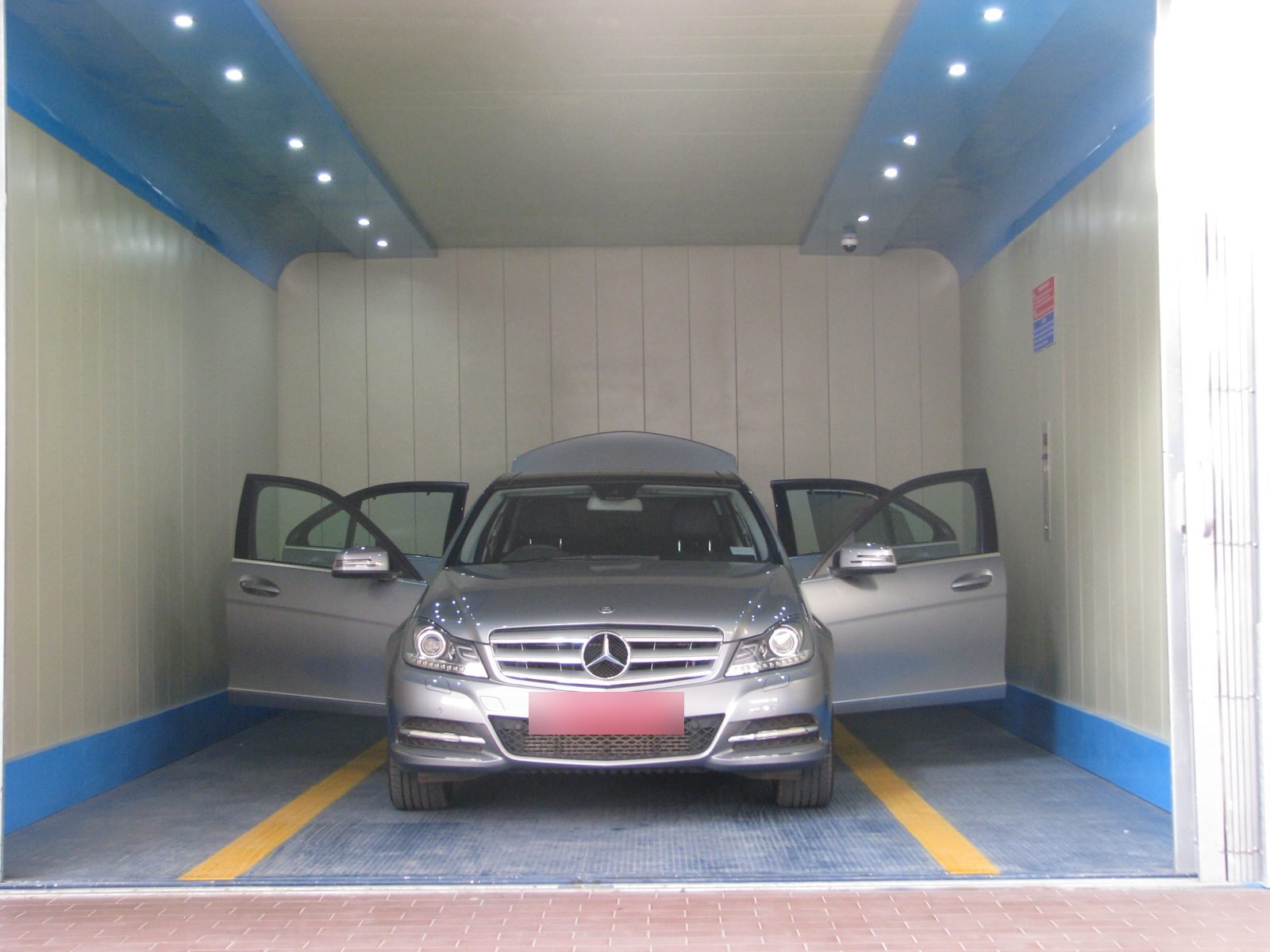
Parking is the scarcest space in Indian cities. Two mechanical answers come up again and again: a car elevator that moves cars between levels, and stack parking that puts one car above another. They solve different problems. This guide shows how each works and which suits a villa, apartment or showroom.
Two ideas, two problems
- Car elevator: the problem is access. You have parking space on another floor, in a basement or on a roof, but a ramp would take too much room.
- Stack parking: the problem is capacity. You have one parking spot and need two cars on it.
Both are types of car parking lift. For a wider view of mechanical systems, see the general overview of automated parking systems.
How a car elevator works
A car elevator is a hydraulic platform or cabin in its own shaft. You drive onto it at one level, press a button and it carries the car to another level, where you drive off. It replaces a ramp, which on a small plot can take up more room than the car park itself.
- Good for basements, rooftops, podium parking and showrooms.
- Can be pit or pitless, with single entry, through entry or 90 degree exit.
- Saves space: no ramps or driveways eating into the plot.
- Suits retrofits into existing buildings.
How stack parking works
In a stack system, one platform lifts a car so another can park beneath, or lowers a car into a pit so another can park above. Our canopy car lift lowers one car below ground and closes the opening with a canopy that carries a second car above, so two cars fit in the space of one. The canopy can be finished in tiles, stone, pavers or grass to match the driveway or garden.
- Good for villas, apartments and city plots with no room for a ramp.
- Cars are enclosed and out of sight when parked below.
- Quiet hydraulics suit residential streets.
- Weather-resistant, with drainage and sealed components.
Side by side
| Car elevator | Canopy car lift (stack parking) | |
|---|---|---|
| Main job | Moves a car between floors | Parks two cars in one space |
| Best for | Basements, rooftops, showrooms, apartments | Villas, driveways, gardens, tight plots |
| Replaces | A ramp | A second parking bay |
| Visible result | A shaft or cabin at the entry | A flat finished surface when closed |
| Operation | Push button at each floor | Wireless remote or panel |
Choosing for your site
- Count the cars you must park and the spaces you have.
- Check whether a ramp could fit. If it cannot, think car elevator.
- Check ground and pit conditions: depth, water table and drainage matter for stack parking below ground.
- Decide who will use it: residents, valet or showroom staff. This affects controls and entry layout.
- Plan power supply and who will maintain it. Mechanical parking needs reliable power and a maintenance plan.
Safety
For either system look for door interlocks, overload protection, limit switches, mechanical locks, anti-fall devices and an emergency stop. A mechanical lock matters most where one car sits above another.
Talk to an engineer
The right answer often depends on a few site measurements. Send plot details and the number of cars on the contact page, or browse all products.