
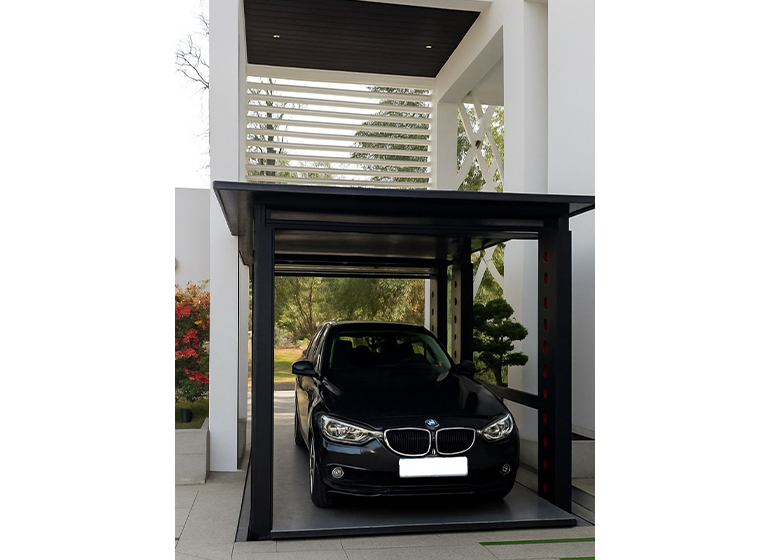
A home lift does not have to mean a passenger lift. Many villa and apartment owners want something more specific: a way to send groceries upstairs, to park a second car or to bring a car down to a basement. Hydraulic lifts do all three. This guide helps you decide which one your home needs and how to plan it.
What hydraulic lifts can do at home
For homes, Hydro Fabs builds dumb waiters for kitchens, and car elevators and canopy car lifts for villas and apartments. Each is built to the home’s layout rather than chosen from a fixed catalogue.
Option 1: a dumb waiter for the kitchen
If the kitchen and dining room are on different floors, a dumb waiter carries food, dishes, laundry and groceries without stair runs. It is quiet, fits a narrow shaft or a wall and can be installed with minimal civil work. Capacity starts from 50 kg. Read the dumbwaiter lift guide.
Option 2: a car elevator for the basement or podium
If your parking is in a basement or on another level and a ramp would eat up the plot, a car elevator moves the car between levels. Pit and pitless models are available, and it can fit into an existing house.
Option 3: a canopy car lift for a second car
Where there is space for one car but you own two, a canopy car lift lowers a car below ground and closes the opening with a canopy you can finish in tiles, stone, pavers or grass. One client described it plainly: the lift saves space by allowing two cars to park in the footprint of one, and the canopy keeps the vehicles safe from weather.
How to plan a home lift
- Start with the problem: carrying food, moving a car or parking a second one.
- Measure: floor-to-floor height, shaft or pit space, driveway or garden dimensions.
- Check the structure: an engineer should review walls, slabs and drainage, especially for a pit.
- Plan power and controls: a power point near the lift, and remote or push-button control.
- Plan finishes: cabin finish for a dumb waiter, canopy surface for a car lift.
- Plan service: an annual maintenance contract (AMC) and a service number you can call.
Safety at home
- Never ride in a dumb waiter. It is for goods only.
- Keep children away from open shafts, pits and moving platforms.
- Look for door interlocks, overload protection, mechanical locks, an emergency stop and manual lowering.
- Use the lift only within its rated load.
- Have it inspected on a regular schedule.
Maintenance and lifespan
A well-maintained hydraulic lift lasts 10 to 20 years or more. Check the oil, hoses and moving parts every few months. In a home, remember that a lift used rarely still needs checking, because seals and oil age even when idle.
Next step
Tell us the floors, the car or the load and your site, and an engineer will advise. Use the contact page, or browse all hydraulic lifts.