A hydraulic lift raises a platform or cabin with pressurised oil instead of ropes and a counterweight. The idea is simple, which is why hydraulic lifts are the usual choice for heavy loads, short travel and buildings with no room for a machine room. This guide explains how one works, what each part does and which safety devices to look for.
The principle: pressure moves a piston
A hydraulic lift works on Pascal’s law: pressure applied to a liquid in a closed system is passed on through the whole liquid. Oil is practically incompressible, so when a pump pushes it into a cylinder, it has nowhere to go except to push the piston outwards. The piston carries the platform, and the platform rises.
Because the force on the piston is the oil pressure multiplied by the piston area, a modest motor can raise a very heavy load smoothly. That is the reason hydraulics are used on goods lifts, car lifts and heavy scissor tables rather than on light equipment alone.
The main parts of a hydraulic lift
- Oil tank (reservoir): holds the hydraulic oil that the system draws from and returns to.
- Electric motor and pump: the motor drives the pump, which pushes oil from the tank towards the cylinder.
- Control valve block: directs the oil. It decides whether the lift goes up, stays still or comes down, and it limits the pressure.
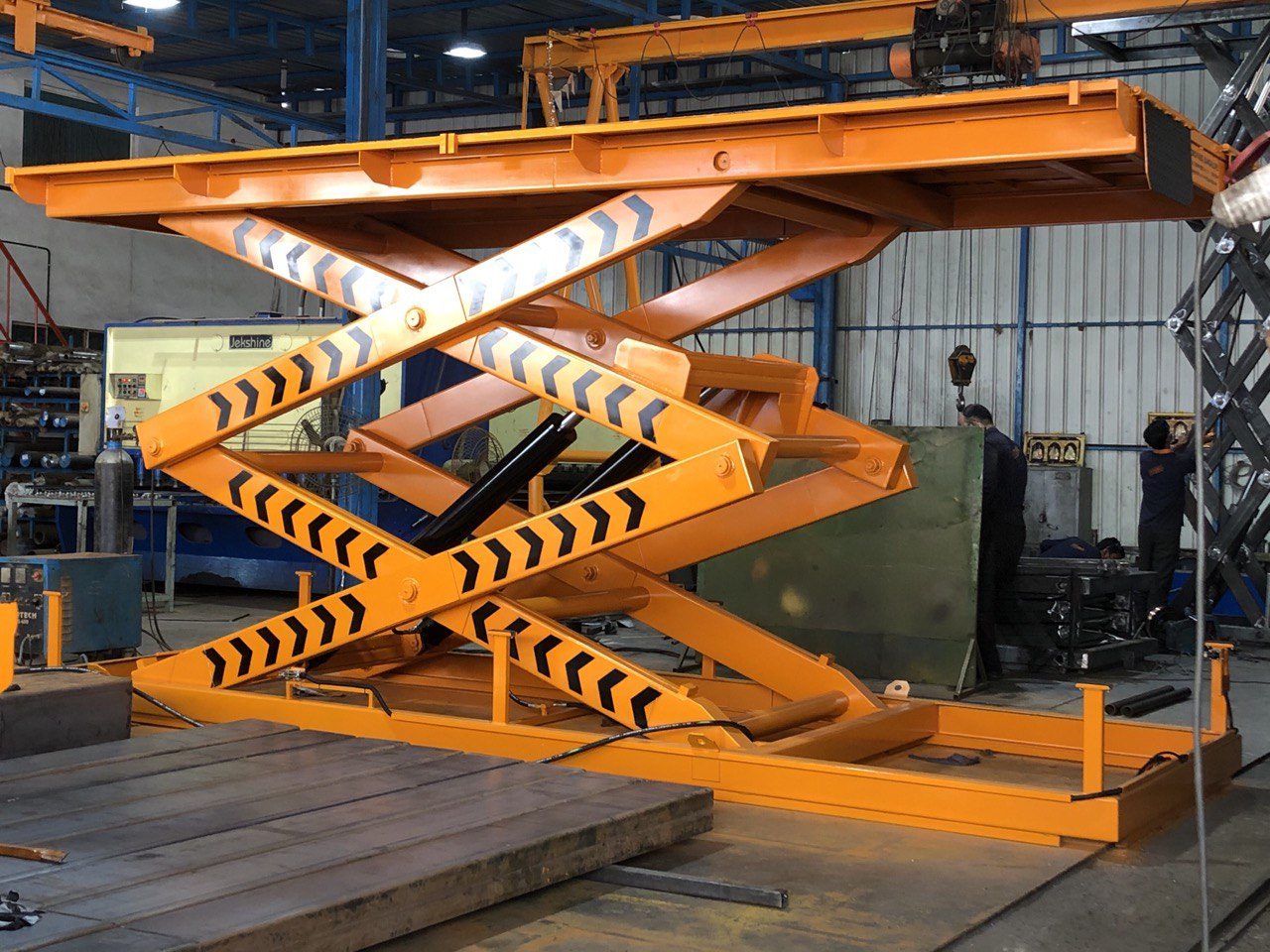
- Hydraulic cylinder and piston (ram): the part that actually lifts. In a scissor lift the cylinders push the scissor arms apart; in a goods lift or car elevator they lift the car frame directly or through a chain or rope arrangement.
- Platform or cabin and guide rails: carry the load and keep it level as it travels.
- Control panel and limit switches: the push buttons the operator uses, and the switches that stop the lift at the top and bottom of its travel.
How it goes up and down
Going up
When you press the up button, the motor starts the pump and the valve sends oil into the cylinder. The piston extends and the platform rises. When you release the button, or the lift reaches a landing, the pump stops and the valve closes, which traps the oil and holds the platform in place.
Coming down
A hydraulic lift does not need the pump to come down. The weight of the platform and load does the work. When you press the down button, a valve opens and lets the oil flow back to the tank at a controlled rate, so the platform descends smoothly. Because the pump is idle on the way down, the motor draws power only while lifting, which is why hydraulic lifts are considered energy efficient for short, heavy duty.
Hydraulic lift vs hydraulic elevator: is there a difference?
No. “Hydraulic lift” and “hydraulic elevator” describe the same technology; “lift” is the common word in India and “elevator” is the word used in many other countries (see the general overview of the elevator). What differs is the job: a goods lift carries materials, a car elevator carries vehicles and a scissor lift raises a platform to a working height. Hydro Fabs builds all three as hydraulic lifts made to your load.
Safety devices to ask for
Hydraulics are safe when the system is designed properly. Whatever lift you buy, ask the manufacturer to confirm these:
- A pressure relief valve so the system cannot be over-pressurised.
- A safety (anti-fall) valve or mechanical lock that stops the platform dropping if a hose or pipe fails.
- Overload protection so the lift will not move beyond its rated load.
- Limit switches and an emergency stop at the control panel.
- Manual lowering so that people or goods are not stuck during a power failure.
- Door interlocks on enclosed lifts, so the lift will not move with a door open.
Hydro Fabs lifts are built to ISI, CE and Indian factory safety standards, with locks, limit switches and emergency stops fitted as standard.
Where hydraulic lifts make the most sense
- Heavy loads over short to medium travel, such as factory goods lifts and loading docks.
- Buildings with no space for a machine room on the roof.
- Retrofits into existing buildings, because a hydraulic lift needs little extra structure above the shaft.
- Car lifts and car elevators where the vehicle has to be moved between levels.
For very tall buildings with fast, frequent passenger travel, rope-driven lifts are normally preferred. We compare the two in hydraulic goods lift vs electric lift.
Maintenance: what a hydraulic lift needs
Keep the oil at the right level and clean, check hoses and fittings for leaks, and have moving parts inspected every few months. A well-maintained lift lasts 10 to 20 years or more, depending on use and care. Hydro Fabs offers Annual Maintenance Contracts (AMC) across India.